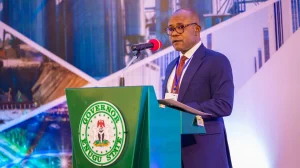
The death of Bayelsa State Deputy Governor Lawrence Ewhrudjakpo has prompted political activity among state leaders and interest groups regarding the appointment of a successor, with key stakeholders engaging in discussions and advocacy on the next deputy governor.
Lawrence Ewhrudjakpo, who served as deputy governor of Bayelsa State, died on Thursday, December 11, 2025.
His death occurred weeks after his involvement in internal state political developments, during which he remained in the Peoples Democratic Party (PDP) while Governor Douye Diri defected to the All Progressives Congress (APC) in November 2025.
Ewhrudjakpo’s passing ended his tenure in office, leaving the deputy governorship vacant. The Nigeria Constitution provides that a governor nominates a new deputy governor subject to confirmation by the state House of Assembly.
The issue of succession has since become a subject of political engagement.
Following the deputy governor’s death, internal discussions among Bayelsa political actors have focused on potential candidates and the criteria for selecting a replacement.
Some stakeholders emphasise zoning of the position to the late deputy governor’s local government area, Sagbama, while others highlight different considerations tied to party interests and political alliances at state and federal levels.
Among individuals mentioned in the broader political discourse are Hon. Ebizi Rosemary Brown Ndiomu, a member of the Bayelsa State House of Assembly representing Sagbama III; Pastor Peter Akpe, Chief of Staff to Governor Diri; and Prince Ebitimi Amgbare, Managing Director and Chief Executive Officer of the Niger Delta Basin Development Authority.
All are noted figures in state politics, cited by sources discussing succession possibilities.
Political observers have also referenced the roles of former Governor and current Senator Seriake Dickson and former President Goodluck Jonathan in Bayelsa’s political dynamics.
Dickson is regarded as a prominent state political figure, while Jonathan’s influence in Bayelsa politics remains noteworthy.
Stakeholders interviewed for source reporting mentioned that zoning, party alignment and future political prospects, including the 2027 general elections, are factors being considered in discussions about the next deputy governor.
The meeting of interests highlights differing perspectives among local and national political actors.
A PDP stalwart involved in discussions said, “The foundational APC members; ‘the old guard’ should now be considered,” listing figures such as Prince Ebitimi Amgbare and Briya Aganaba for consideration.
An APC chieftain said, “To me, Sagbama should retain the position. The state is now APC. What we should be considering is integrity. Whoever the governor appoints must be credible and not someone already compensated with political office.”
The process of selecting a new deputy governor in Bayelsa is part of broader political activity in the Niger Delta and Nigeria’s sub‑national governance.
The appointment will affect the political balance in Bayelsa State as the country prepares for the 2027 general elections. It also reflects how intra‑party negotiations and zoning considerations shape political appointments.