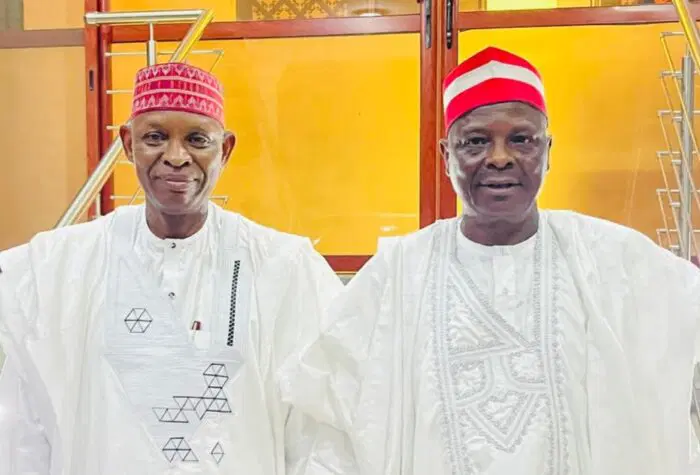
Tensions in Kano State’s political landscape intensified on Wednesday, January 28, 2026, as Senator Rabiu Musa Kwankwaso, national leader of the New Nigeria Peoples Party (NNPP), criticised Governor Abba Kabir Yusuf’s recent defection to the All Progressives Congress (APC).
Meanwhile, Governor Yusuf approved fresh appointments to strengthen his administration ahead of the 2027 general elections.
Governor Yusuf formally defected from the NNPP to the APC on January 26, 2026, marking a significant shift in the state’s political alignment less than three years after winning the governorship on the NNPP platform.
His victory in 2023 was largely attributed to the political support of Kwankwaso and the Kwankwasiyya movement, which propelled the party to prominence in Kano.
Senator Kwankwaso has been openly critical of the decision, describing it as a betrayal of the political movement that supported Yusuf’s rise to power.
The development has deepened divisions within Kano’s political circles and raised questions about party loyalty and strategy ahead of the 2027 elections.
Kwankwaso said the governor’s departure from the NNPP was surprising and difficult for many to understand.
He spoke in an interview with the BBC Hausa Service, telling supporters that “many people have approached me saying they believe what happened was part of some arrangement,” and that he struggled to reconcile the events surrounding the defection. He warned that Yusuf and his associates would come to regret abandoning the NNPP.
The NNPP leader described the governor’s move as a surrender of the party’s mandate and support base to the APC and expressed confidence that the consequences of the decision would become clear over time.
“Even if he does not return, he will regret it,” Kwankwaso said in comments that have resonated with party loyalists.
In response to political developments, Governor Yusuf signed off a series of appointments and promotions within his government aimed at consolidating his political foothold and strengthening governance ahead of critical electoral contests.
The appointments included senior advisory positions and leadership changes at key state agencies.
Among those appointed were Abdulkadir Balarabe Kankarofi as Special Adviser on Humanitarian Affairs, Hajia Aisha Tamburawa as Special Adviser on Positive Propaganda, Engr. Mukhtar Yusuf as Managing Director of the Water Resources Engineering and Construction Agency, and Dr. Mukhtar Bello Maisudan as Executive Secretary of the Kano State Scholarship Board. Several directors and agency heads were also named in the reshuffle.
Kwankwaso said: “Many people have come to me saying they believe what happened was part of some arrangement.
Even I, on several occasions, find it hard to believe that events have unfolded the way they did.” He added that time will reveal the full consequences of the governor’s decision.
The intensifying political contest in Kano illustrates deeper fractures within Nigeria’s political parties as the 2027 general elections approach.
Observers note that shifts in party loyalty by prominent figures such as Governor Yusuf could influence voter sentiment and strategic alignments not only in Kano State but also in broader national politics.
The debate over party identity, loyalty and political strategy is likely to shape public discourse ahead of future elections.
The unfolding dispute between Senator Rabiu Musa Kwankwaso and Governor Abba Kabir Yusuf highlights a significant political shift in Kano’s landscape.
As Yusuf strengthens his base within the APC and Kwankwaso seeks to rally his supporters within the NNPP, political tensions are poised to influence electoral dynamics in the state and beyond ahead of the 2027 general elections.