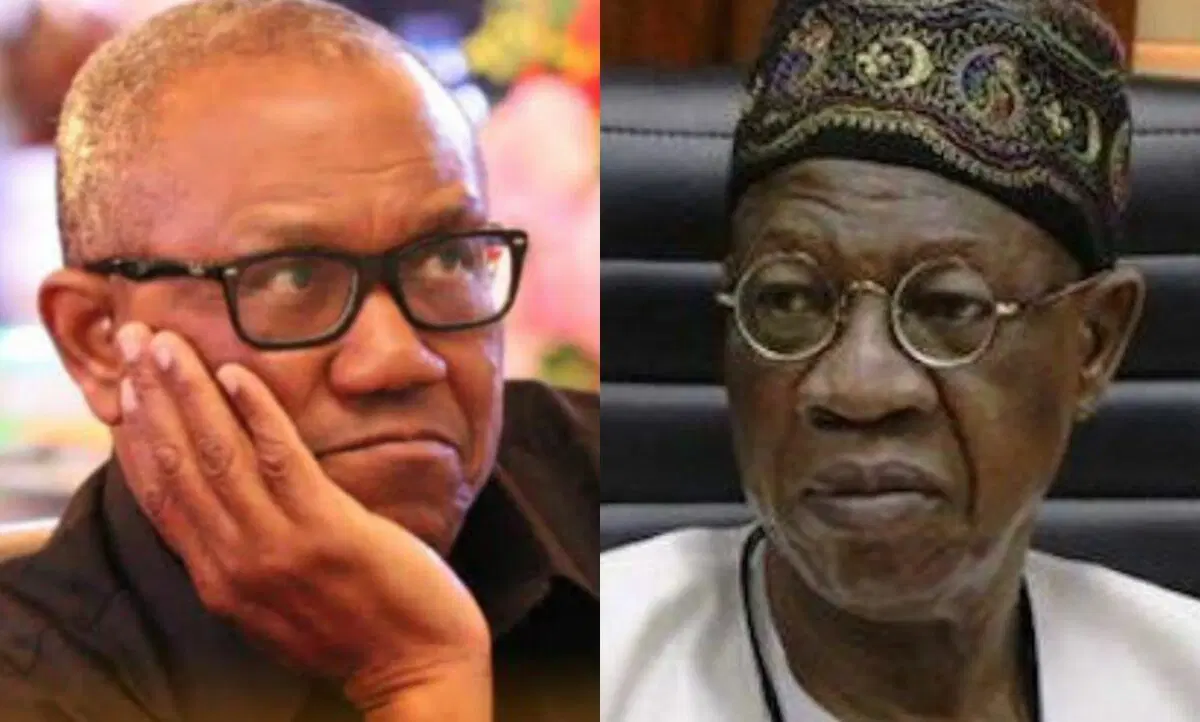
The Minister of Information and National Orientation, Alhaji Lai Mohammed, has said that former presidential candidate Peter Obi would still not have won the 2023 presidential election even if he had secured an additional 10 million votes. He made the remarks during an interview with reporters on Monday, February 2, 2026.
Peter Obi was the presidential candidate of the Labour Party in Nigeria’s February 2023 general elections.
The contest was won by President Bola Ahmed Tinubu of the All-Progressives Congress (APC), with major opposition candidates including Obi and Atiku Abubakar of the Peoples Democratic Party (PDP). The election outcome was controversial and followed by legal challenges.
Lai Mohammed’s comments respond to ongoing public debates about Obi’s electoral support and the significance of his vote totals, particularly among young and urban voters, who were seen as a strong constituency for the Labour Party.
After the 2023 elections, some political observers suggested that higher voter turnout or broader regional support might have produced different results for Obi.
In the media interview, Mohammed said that even with an additional 10 million votes in Obi’s column, the overall result of the 2023 presidential election would not have changed.
He attributed this to Nigeria’s diverse and regionally segmented electorate, asserting that the election result reflected broader national voting patterns beyond raw vote totals. He also referenced the distribution of votes across states and zones as a major factor in determining the winner.
Mohammed argued that major political parties must build broad national coalitions to win presidential elections in Nigeria, given the country’s geographic and ethno-religious diversity.
According to him, securing high vote counts in limited regions or demographics is not sufficient to achieve victory. Addressing the media, Lai Mohammed said: “Even if Obi had 10 million more votes, he still would not have won the 2023 election.
The requirement for victory in Nigeria is not simply getting more votes in a few states but meeting the constitutional threshold across many states to reflect national spread.”
Mohammed’s statement contributes to continuing national discussion about the 2023 election, voter mobilisation, and the strategies political parties employ to broaden their appeal.
His remarks also emphasise considerations around geographic distribution of votes and constitutional requirements for presidential victory in Nigeria. Analysts say such debates can influence future campaign strategies and public expectations in the run-up to the 2027 elections.
Information Minister Lai Mohammed has reiterated that even a hypothetical 10 million additional votes for Peter Obi in the 2023 election would not have changed the outcome.
His comments highlight debates about national electoral strategy and the complexity of winning presidential contests in Nigeria’s diverse political landscape.