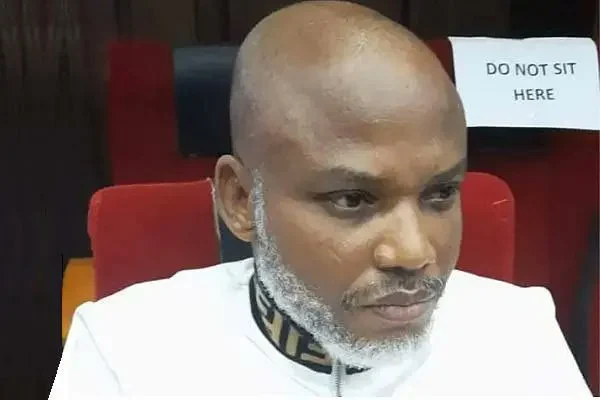
The Deputy President‑General of Ohanaeze Ndigbo, Okechukwu Isiguzoro, has urged President Bola Tinubu to consider pardoning the detained leader of the Indigenous People of Biafra (IPOB), Nnamdi Kanu, as part of political measures to bolster national stability and support for the president’s bid for re‑election in 2027.
The appeal was made in an interview with Sunday PUNCH on January 18, 2026.
Isiguzoro said that pardoning Kanu, suspending the recently introduced tax law and fully implementing the 2014 National Conference report would help “stabilise the polity” and address growing opposition to Tinubu’s second‑term ambition. He said that failure to take these steps could imperil the president’s political prospects.
He asserted that the political environment in the country was becoming “hostile” to the president, with various interest groups aligning against him. According to Isiguzoro, a presidential pardon for Kanu would ease political tensions in the South‑East and weaken separatist agitation ahead of the 2027 polls.
“There are powerful forces across the country working against Tinubu,” Isiguzoro said. “They include northern elites, Middle Belt leaders, angry business moguls, and retired military and political power brokers. The President must act decisively to neutralise them.”
He advised that granting the pardon “before 2027—preferably on June 12 or October 1—will change the political temperature in the South‑East and deny the opposition a powerful mobilisation tool.”
Isiguzoro also called on the president to urgently revisit and suspend the newly introduced tax law, which he said had alienated business interests and private‑sector players.
He warned that “many business moguls are already funding opposition movements quietly because of the tax policy,” and criticised the measure as a dangerous front the administration cannot ignore.
In addition to the pardon and tax policy, the Ohanaeze leader advocated for the implementation of the 2014 National Conference report, describing it as a “game changer” capable of reshaping Nigeria’s political structure and reducing regional grievances.
He said that visible infrastructure projects completed before the 2027 election would also enhance the All-Progressives Congress’s (APC) electoral prospects in regions where it has historically struggled.
Isiguzoro further suggested that the creation of additional states across all six geopolitical zones could broaden the president’s national appeal. “Tinubu must not underestimate the conspiracy against him,” he said, noting that the opposition was already exploring alliances to block the president’s re‑election.
Calls for a presidential pardon for Kanu have been echoed by other stakeholders in recent months, including the South‑East caucus of the House of Representatives, which urged the president to use constitutional powers under Section 175 of the 1999 Constitution for a political and humanitarian intervention in Kanu’s case.
Ohanaeze’s appeal highlights ongoing national debate on President Tinubu’s leadership strategy ahead of the 2027 general elections, with political actors across regions urging actions they believe will foster peace, inclusivity and broad national support.