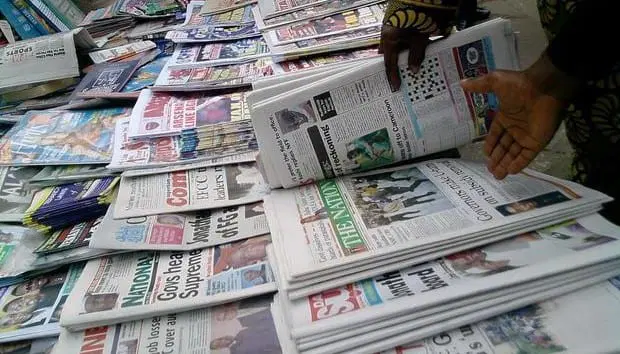
Security reforms, fiscal policy changes and economic developments dominated major Nigerian newspaper headlines on Thursday, with renewed calls for the immediate state police establishment taking centre stage across the country. A review of leading national dailies showed growing attention on efforts to strengthen Nigeria’s security architecture, alongside reports on tax reforms, crude oil price movements, healthcare concerns and federal revenue allocations.
Leading the headlines, Vanguard reported that the nation’s 36 state governors have once again backed the immediate creation of state police as part of broader efforts to address persistent insecurity. According to the report, the governors emphasized that any framework for state police establishment must be constitutionally grounded, aligned with federal principles and designed to protect citizens’ rights.
The renewed support reflects increasing pressure for decentralised policing as communities across different regions continue to grapple with terrorism, banditry, kidnapping and other violent crimes. The governors’ position adds momentum to ongoing discussions within the National Assembly, where lawmakers are considering constitutional reforms aimed at restructuring the country’s security framework.
Vanguard also highlighted developments in the international energy market, reporting a sharp decline in crude oil prices. The drop followed indications of an interim understanding between the United States and Iran, which improved expectations of increased global oil supply.
Market analysts noted that easing tensions between the two countries could help stabilise energy markets and reduce fears of supply disruptions that had previously pushed prices upward. For Nigeria, a major crude oil exporter, fluctuations in global oil prices remain significant because of their impact on government revenues and foreign exchange earnings.
Another major development featured by Vanguard was the Federal Government’s release of implementation guidelines for the Tax Acts 2025. The guidelines provide a framework for transitioning from repealed tax laws to the new tax regime, which officially came into effect on January 1, 2026.
Government officials said the document is intended to provide clarity for businesses, tax administrators and taxpayers as the country adjusts to the new fiscal framework. The transition is expected to influence revenue collection processes and strengthen compliance across different sectors of the economy.
In the health sector, The Guardian focused on activities marking World Sickle Cell Day, drawing attention to growing concerns about inaccurate genotype testing in parts of Nigeria. The report highlighted complaints involving incorrect laboratory readings, misdiagnoses and alleged falsification of genotype results.
Health stakeholders called for stricter regulation, improved laboratory standards and greater oversight to ensure the accuracy of genetic testing. Experts warned that incorrect genotype information could have serious consequences for families, particularly in a country where sickle cell disease remains a major public health challenge.
The Punch led with reports that N500 billion was deducted from the Federation Account Allocation Committee (FAAC) revenue for May 2026 to finance a national security emergency intervention.
According to sources familiar with the development, the funds were earmarked to support ongoing efforts to address security challenges across the country. The report comes at a time when discussions around security funding and institutional reforms continue to intensify among policymakers and stakeholders.
The Nation also placed security at the forefront of its coverage, reporting that lawmakers, security experts and other stakeholders are pursuing measures to strengthen Nigeria’s security architecture.
The newspaper highlighted efforts aimed at legislative reforms, sustainable intelligence funding and the push for state police establishment as part of broader strategies to confront terrorism, banditry and kidnapping. Stakeholders argued that strengthening local security capabilities, improving intelligence gathering and enhancing cooperation among security agencies are essential to addressing the country’s evolving security threats.
Across the nation’s newspapers, security remained the dominant issue shaping public discourse. From renewed calls for state police establishment to debates over security funding and institutional reforms, the headlines reflected growing concern about Nigeria’s security challenges. Alongside these developments, tax policy implementation, healthcare standards and global oil market movements also featured prominently, underscoring the wide range of issues influencing governance, economic stability and public welfare in the country.