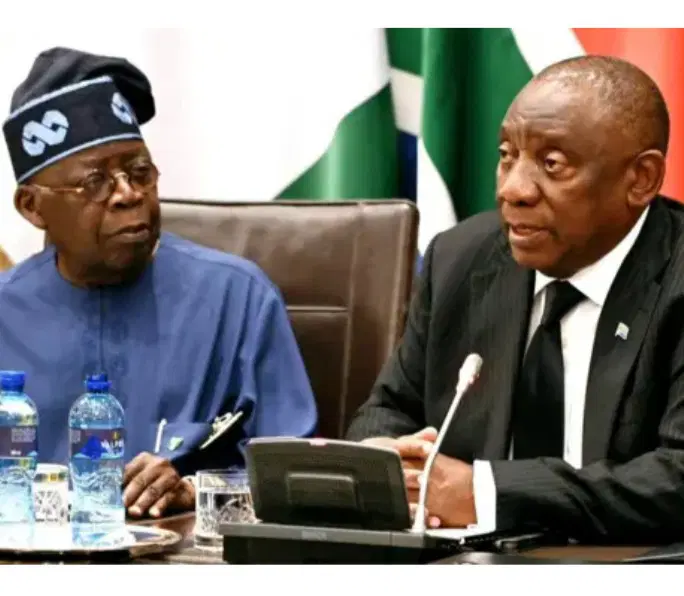
President Bola Tinubu has reportedly declined to receive a special envoy sent by South African President Cyril Ramaphosa, amid renewed concerns over persistent xenophobic attacks targeting Nigerians in South Africa. The reported diplomatic decision came as outrage grew over the alleged killing of a Nigerian citizen, Chika Ibe, during a police operation in Cape Town.
According to sources familiar with the development, the South African delegation, led by the country’s Minister of International Relations and Cooperation, Ronald Lamola, arrived in Abuja on July 24 with what officials described as an important message for the Nigerian President.
However, the planned audience reportedly did not take place after Nigeria’s Minister of Foreign Affairs, Ambassador Bianca Odumegwu-Ojukwu, advised the Presidency that the timing was inappropriate given the continued attacks on Nigerians and their businesses in South Africa. Sources said the minister maintained that the delegation could not meet President Tinubu without prior approval and tangible commitments from Pretoria.
Officials familiar with the matter said Nigeria insisted that South Africa should first present a signed copy of the Memorandum of Understanding on the Early Warning Mechanism before further diplomatic engagement. The agreement, signed in Abuja on October 22 last year, was designed to strengthen cooperation between both countries in preventing violence, protecting citizens and improving communication during security-related incidents involving foreign nationals.
According to Nigerian officials, South Africa has yet to ratify the agreement, delaying its implementation. They also noted that the framework could have supported compensation claims for Nigerians whose businesses and properties were destroyed during previous xenophobic attacks.
The reported diplomatic standoff followed the death of Chika Ibe, a Nigerian national who allegedly died after an encounter with members of the South African Police Service in Cape Town. While South African authorities said Ibe became unwell during an arrest linked to the discovery of an unlicensed firearm and suspected drugs, video footage circulating among members of the Nigerian community reportedly presents a different account of the incident.
The footage allegedly shows Ibe, who had already sustained injuries, being shot while police officers remained at the scene, triggering protests from Nigerians living in the area.
South Africa’s Independent Police Investigative Directorate confirmed that investigations into the incident have commenced. Initial post-mortem findings reportedly revealed multiple bruises and abrasions on Ibe’s body, while authorities continue examining the circumstances surrounding his death. The country’s Inter-Ministerial Committee on Migration also confirmed that the matter remains under investigation.
The Tinubu South Africa envoy development comes as Nigeria continues to push for stronger continental action against xenophobic attacks.
At the 69th Ordinary Session of the ECOWAS Authority of Heads of State and Government in Sierra Leone, Vice President Kashim Shettima, representing President Tinubu, condemned recurring attacks on Africans living in South Africa and pledged that Nigeria would advocate stronger anti-xenophobia measures at the African Union. He also disclosed that the Federal Government had evacuated 1,490 Nigerians affected by previous xenophobic violence, reaffirming Nigeria’s commitment to protecting its citizens both within and outside the country.