The Peoples Democratic Party (PDP) is facing renewed scrutiny over internal divisions as political developments and legal disputes continue to affect the party’s structure ahead of Nigeria’s 2027 general elections.
Recent events have raised questions about the party’s unity and its ability to maintain cohesion within its leadership ranks.
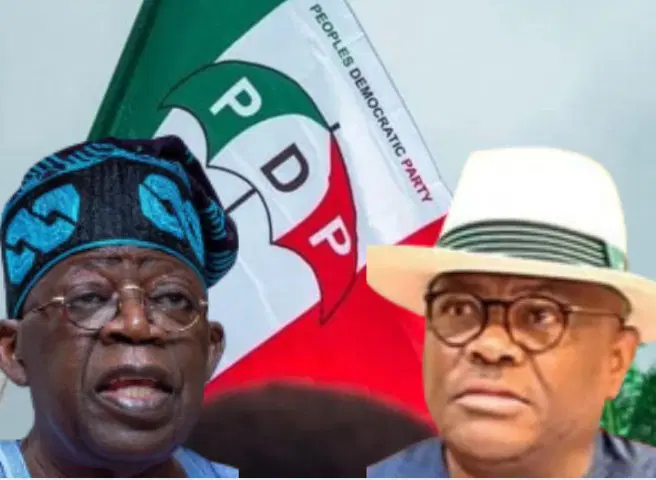
The discussion gained attention following political tensions within the party and reactions to the role of the Minister of the Federal Capital Territory, Nyesom Wike, who remains a prominent figure in the PDP despite serving in the administration of President Bola Ahmed Tinubu of the ruling All Progressives Congress (APC).
The PDP has experienced a prolonged internal crisis that predates the current debate. Tensions escalated after disputes over party leadership and the outcome of a national convention held in Ibadan in November 2025.
A ruling by the Court of Appeal in Abuja recently upheld a Federal High Court decision that nullified the convention which produced Kabiru Tanimu Turaki as the party’s national chairman.
The judgment intensified the leadership uncertainty already affecting the party’s national structure.
Political observers note that the crisis has created divisions among party members across different factions, with disagreements over leadership recognition and political direction within the party.
At the grassroots level, some party supporters have expressed concern about the situation. Reports from areas around the PDP national secretariat in Wuse Zone 5, Abuja, indicate that political mobilisation has been affected by the internal disagreements.
A local supporter, Musa Sani, who has traditionally participated in party mobilisation activities, said enthusiasm among supporters was noticeably lower during recent local council elections in the Federal Capital Territory.
“We printed plenty. But the excitement was not there like before,” he said while referring to unused campaign posters.
The internal debate within the PDP reflects broader concerns about leadership cohesion, party discipline, and strategic direction ahead of the next election cycle.
Discussions among party members have also focused on how internal disputes and factional alignments could influence the party’s organisational stability.
Political figures within and outside the party have offered differing interpretations of the situation, with some attributing the tensions to internal disagreements while others link them to broader political dynamics within Nigeria’s multi-party system.
As one of Nigeria’s major opposition parties, the PDP’s internal stability is considered significant for the country’s political balance.
Developments within the party may influence opposition politics, coalition building, and electoral competition as the 2027 general elections approach.