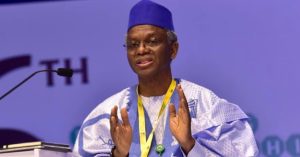
The Independent Corrupt Practices and Other Related Offences Commission (ICPC) has announced that it will arraign former Kaduna State Governor Nasir El‑Rufai and one Joel Adoga before the Federal High Court, Kaduna Judicial Division, on Tuesday, March 24, 2026, on alleged corruption‑related offences, the agency said on Monday.
In a statement issued by the commission’s Head of Media and Public Communications, John Odey, the ICPC said the suit number FHC/KD/73/2026 charges the former governor and Adoga with conversion and possession of public property as well as money laundering, among other offences.
The commission’s announcement confirmed that El‑Rufai and Adoga are scheduled to be formally arraigned later in the week before a judge of the Kaduna Federal High Court.
The ICPC’s statement did not provide further details about specific counts beyond the categories of alleged offences in the charges it filed.
El‑Rufai, who served as governor of Kaduna State from May 2015 to May 2023 and was later a founding member of the All Progressives Congress (APC) before joining the African Democratic Congress (ADC) in November 2025, was taken into ICPC custody following his voluntary attendance at the Economic and Financial Crimes Commission (EFCC).
The ICPC’s move to arraign him follows other actions by the commission involving the former governor.
A Federal High Court in Abuja recently granted the ICPC access to analyse digital devices and electronic data recovered from El‑Rufai’s residence in Abuja as part of the ongoing probe.
The arraignment plan comes amid statements by external groups such as the African Democratic Congress, which demanded that the ICPC either release or charge El‑Rufai within a reasonable timeframe as part of due process.
According to the ICPC statement, the charges El‑Rufai and Adoga are expected to face include allegations of conversion and possession of public property and money laundering, reflecting offences under Nigeria’s anti‑graft laws.
Conversion and possession of public property generally involve allegations that a public official used state assets for personal benefit, while money laundering charges typically relate to the alleged concealment or movement of financial proceeds from criminal activity.
Once the case is opened in court, a judge will formally read the charges to the defendants and set dates for the next stages of the legal process.
The Federal High Court, Kaduna Judicial Division, is a federal court with jurisdiction over serious criminal and civil matters, including corruption and related offences.
The arraignment represents the first procedural step in a criminal trial, after which the court will determine bail conditions and future hearing dates.
The planned arraignment reflects actions by Nigeria’s anti‑corruption agencies to pursue legal accountability in high‑profile cases involving former public officials.
Under the Constitution and anti‑corruption frameworks, suspects are entitled to due process, including formal charges, the right to legal representation, and judicial determination of guilt or innocence.