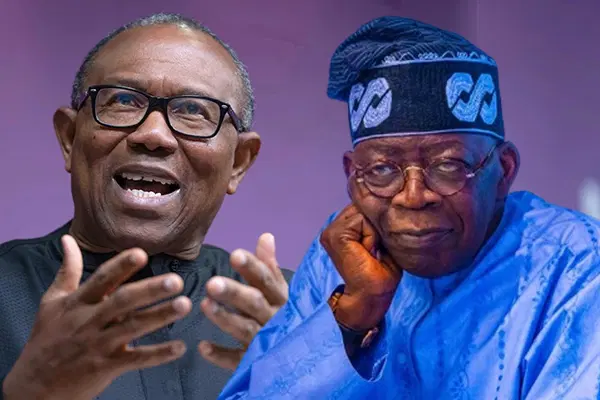
Reject Tinubu as Labour Party’s 2023 presidential candidate, Peter Obi, called on Nigerians to vote against President Bola Tinubu in the next election, citing persistent power failure and unmet electricity promises.
The call to Reject Tinubu comes amid continued concerns over Nigeria’s electricity supply, which remains a major issue affecting households, businesses, and industrial productivity.
Power generation challenges, rising tariffs, and inconsistent supply have remained central to national discourse.
During the 2023 election campaign, President Bola Tinubu made commitments to improve electricity supply, which are now being referenced in current political debates.
Obi’s remarks reflect increasing political engagement as stakeholders begin to position themselves ahead of the 2027 general elections.
In a statement shared on his official X account, Obi urged Nigerians to Reject Tinubu, referencing a campaign promise made by the President.
“If I don’t give you constant electricity in four years, don’t vote for me for a second term,” Obi quoted Tinubu as saying.
Obi argued that current realities in the power sector indicate that the condition has not been met. He described the situation as a failure to deliver on a key national promise.
He also noted that electricity generation has declined from levels recorded at the start of the administration, while tariffs have increased, placing additional pressure on citizens and businesses.
Expanding on his position, Obi used available data to support the call to Reject Tinubu, highlighting Nigeria’s low electricity consumption levels.
He stated that Nigeria’s per capita electricity consumption is about 144 kilowatt-hours, significantly below Africa’s average of 617 kilowatt-hours.
According to him, the figures reflect broader structural challenges within the power sector and underscore the need for effective policy implementation.
He also linked the situation to economic productivity, noting that inadequate power supply affects small businesses and industrial growth.
As part of his remarks, Obi referenced a recent incident involving the President during a visit to Jos, using it to reinforce his position to Reject Tinubu.
He cited a comment attributed to the President regarding lack of electricity at an airport, presenting it as an example of the challenges faced across the country.
The reference was used to illustrate the gap between policy expectations and everyday realities.
The call to Reject Tinubu introduces a clear political message as discussions around governance performance intensify.
Electricity supply remains a critical factor in evaluating government performance, with implications for economic development and public welfare.
As political activities increase ahead of the 2027 elections, issues such as power supply, cost of living, and infrastructure are expected to shape voter decisions.
The statement to Reject Tinubu reflects a broader trend of political accountability, where past campaign promises are being revisited as benchmarks for performance.
Across Nigeria, political actors are increasingly using governance outcomes to frame their positions and engage with the public.
The development highlights the growing importance of measurable outcomes in shaping political discourse.