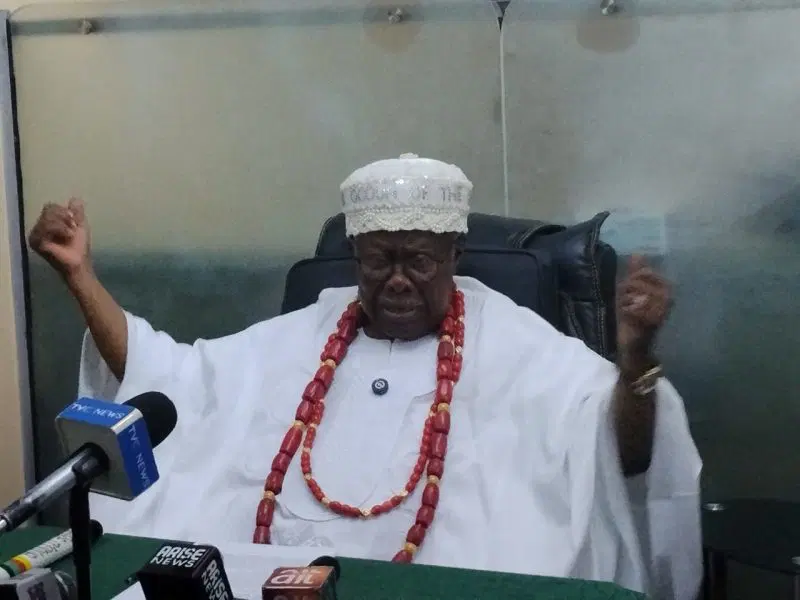
Former Deputy National Chairman of the Peoples Democratic Party (PDP), Chief Bode George, has called on the National Judicial Council (NJC) to take decisive steps to preserve Judicial Independence, expressing concern over a recent court judgment connected to the party’s leadership dispute. George made the appeal on Friday through an open letter addressed to the Chairman of the NJC, arguing that the issues raised extend beyond the PDP and have implications for constitutional governance and public confidence in Nigeria’s judiciary.
George, who is also a member of the PDP Board of Trustees (BoT), stated that he wrote as “a concerned citizen, a democrat, and a member of the Board of Trustees of the Peoples Democratic Party,” following developments he said had generated serious concerns about the administration of justice and the courts’ constitutional role.
According to him, the lawsuit was instituted by the Chairman and members of the PDP Board of Trustees to compel the Independent National Electoral Commission (INEC) to comply with existing judgments of the Supreme Court, Court of Appeal, and Federal High Court by updating its records to recognize what he described as the authentic leadership of the party under Mr. Kabiru Tanimu Turaki (SAN).
He maintained that rather than determining the constitutional issues presented before it, including whether INEC was legally obligated to implement the existing judgments, the court dismissed the suit as a waste of judicial time. George further noted that the court awarded costs of N140 million against the PDP Board of Trustees and an additional N10 million against its counsel.
Describing the judgment as troubling, George argued that the matter goes beyond internal party disagreements and raises broader questions about constitutional democracy and the rule of law in Nigeria. He also criticized the reported expulsion of senior PDP members by the faction aligned with the Minister of the Federal Capital Territory, Nyesom Wike, describing the action as inconsistent with the party’s organizational structure.
“It is the greatest joke in the civilised international community today. Morally and ethically is it possible for a child to expel a father from his house whilst the father is still alive,” George stated.
In his letter, he emphasized that judgments of the Supreme Court remain final and binding on all persons and authorities across the federation, while decisions of other superior courts must equally be respected until overturned by a competent court. He stressed that no administrative authority has the legal power to disregard or delay compliance with valid court judgments.
George also reminded the NJC of its constitutional responsibility under Paragraph 21 of Part I of the Third Schedule to the 1999 Constitution (as amended) to safeguard the independence, integrity, discipline, and ethical standards of the judiciary. He argued that whenever judicial decisions generate widespread public concern, the Council has a duty to protect public confidence in the courts.
“The Judiciary remains the last hope of the common man only so long as the common man remains convinced that justice is administered according to law, guided by the Constitution, and uninfluenced by power or expediency,” he said. He urged the NJC to discharge its constitutional mandate with impartiality and firmness, insisting that preserving the integrity of the judiciary is essential to maintaining the rule of law, democratic governance, and public trust in Nigeria’s constitutional institutions.