
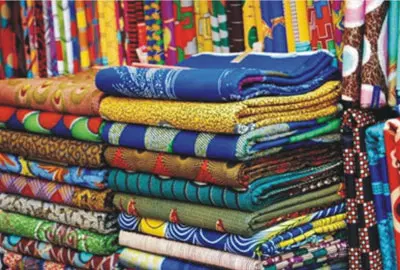
Nigeria’s textile import bill has climbed to N1.08 trillion, highlighting the country’s growing dependence on foreign fabrics despite repeated efforts to revive domestic manufacturing.
Data from the National Bureau of Statistics showed that textile imports increased by 181 per cent from N377.47 billion in 2023 to N1.08 trillion in 2025. The upward trend has continued into 2026, with imports reaching N267.7 billion in the first quarter, representing a 153.2 per cent increase from N70.48 billion recorded during the same period in 2025.
The NBS figures showed that textile imports rose 92.4 per cent in 2024, reaching N726.18 billion from N377.47 billion the previous year. The figure increased by another 46 per cent in 2025 to cross the N1 trillion mark.
Quarterly data also reflected the persistent increase, with imports rising from N178.45 billion in the first quarter of 2024 to N228.83 billion in the corresponding quarter of 2025 before reaching N267.7 billion in Q1 2026. At the current pace, the import bill could approach N1.4 trillion by the end of 2026.
Industry operators have linked the development to weak domestic production, high energy costs, inadequate electricity supply, foreign exchange pressures and other structural constraints. Meanwhile, textile exports have moved in the opposite direction. Exports fell to N16.55 billion in 2025 from N18.76 billion in 2023 and were 55 per cent below the N36.98 billion recorded in 2024.
The worsening figures have renewed calls for stronger protection of Nigeria’s textile manufacturers. In June 2026, the Senate adopted a resolution urging the Federal Government to impose a total ban on imported textiles.
The lawmakers said foreign products currently account for about 99 per cent of Nigeria’s domestic textile market, warning that continued dependence on imports was undermining the survival of local mills. The Senate specifically called for measures to revive textile factories along the Kaduna-Kano industrial corridor.
It also urged the Ministry of Agriculture to expand cotton production, describing local cotton farming as critical to rebuilding the textile value chain. Other recommendations included increased intervention financing through the Bank of Industry and stronger surveillance to tackle textile smuggling.
The Manufacturers Association of Nigeria, however, warned that an import ban without broader reforms could produce limited results. MAN Director-General, Segun Ajayi-Kadir, said Nigeria had the capacity to meet a substantial portion of its textile needs but needed policies that would make local production competitive. He questioned whether the government was prepared to lead by example through the purchase of locally manufactured textiles.
“For instance, are we going to enforce the patronage of made-in-Nigeria textiles within the government? When the National Assembly passed this resolution, how many of them were wearing made-in-Nigeria garments?” he asked.
Ajayi-Kadir said any restriction should be supported by effective implementation of Executive Order 003 and the Federal Government’s Nigeria First policy. He argued that government agencies, including the Presidency, National Assembly, military, paramilitary organisations and public schools, should prioritise locally manufactured fabrics and uniforms.
The Nigeria Textile Manufacturers Association took a different position, backing stronger protection for domestic producers. Its Director-General, Dr Hamma Ali Kwajaffa, said unchecked imports, smuggling and dumping had contributed significantly to the collapse of Nigeria’s textile manufacturing base. He said the association supported comprehensive measures to restore the competitiveness of local factories, including stricter border controls and stronger enforcement of trade regulations.
Kwajaffa, however, acknowledged that import restrictions alone could not revive the industry. He identified inadequate raw materials, high production costs, poor infrastructure, insecurity and limited access to affordable financing as major obstacles.
He particularly highlighted the collapse of domestic cotton production, saying manufacturers were struggling to obtain adequate raw materials. The association called for stronger incentives for cotton farmers, improved agricultural extension services and deliberate efforts to rebuild the country’s cotton value chain.
The Centre for the Promotion of Private Enterprise strongly opposed a blanket import ban, warning that the policy could hurt businesses that currently depend on imported fabrics. CPPE Chief Executive Officer, Dr Muda Yusuf, said the restrictions could disrupt Nigeria’s estimated N10 trillion garment, tailoring and fashion industry, as well as the N7 trillion furniture sector.
He also warned that nearly 10 million jobs could be exposed to disruption. According to Yusuf, many micro, small and medium enterprises in the garment and fashion sectors rely on imported fabrics because domestic manufacturers currently cannot provide sufficient quantities, varieties or quality to meet market demand. He argued that banning imports under current conditions could increase production costs, fuel inflation and encourage smuggling.
“The challenge confronting Nigeria’s textile industry is fundamentally one of competitiveness rather than import penetration,” Yusuf said.
He identified high energy costs, expensive credit, obsolete technology and inadequate infrastructure as some of the factors preventing local manufacturers from competing effectively.
Yusuf called for a broader industrial strategy instead of relying principally on import restrictions. His recommendations included rebuilding domestic cotton production, expanding access to affordable financing, improving electricity supply, modernising production technology and strengthening border controls. He also advocated greater use of government procurement to create a reliable market for locally manufactured textiles.
The conflicting positions reflect the difficult policy choice confronting the Federal Government: protect struggling textile manufacturers without destabilising the millions of businesses and workers whose operations currently depend on imported materials. With textile imports continuing to rise while exports and domestic manufacturing remain weak, industry stakeholders increasingly agree on one point: lasting revival will require Nigeria to rebuild the competitiveness of the entire textile value chain.