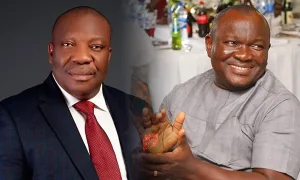
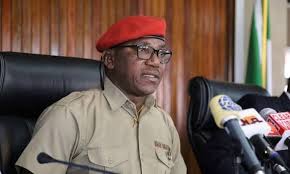
El-Rufai made greatest mistake by surrendering himself, former Minister of Youth and Sports Development, Solomon Dalung, said. While offering detailed criticism of the actions taken by former Kaduna State governor, Nasir El-Rufai, following his recent arrest and detention by anti-corruption agencies.
Dalung spoke during an interview on Trust TV, where he outlined his position on the circumstances surrounding the case and the response of the former governor.
Nasir El-Rufai, who served as governor of Kaduna State from 2015 to 2023, has recently been at the centre of legal scrutiny involving allegations of financial misconduct and abuse of office.
His case has attracted national attention due to his political profile and previous role in federal governance.
Reports indicate that the Economic and Financial Crimes Commission (EFCC) initially took El-Rufai into custody before he was subsequently re-arrested by the Independent Corrupt Practices and Other Related Offences Commission (ICPC).
The sequence of events surrounding his arrest, detention, and transfer between agencies has generated public debate and commentary from political stakeholders.
Dalung, a former member of the Federal Executive Council, weighed in on the issue by assessing both the legal and political implications of El-Rufai’s decisions during the process.
Dalung stated that El-Rufai made greatest mistake by surrendering himself, arguing that the former governor’s decision to submit voluntarily to authorities altered the dynamics of the situation.
“El-Rufai himself decided to downplay and surrender himself and that’s the greatest mistake he made as a comrade,” Dalung said.
He explained that, according to his account, there had been an earlier attempt by security operatives to arrest El-Rufai at an airport, which did not succeed.
Dalung suggested that concerns about potential public reaction may have influenced how authorities handled the situation at that stage.
Dalung further described surrendering as a strategic disadvantage in confrontations involving state institutions. “Comrades don’t surrender. During a struggle, if you surrender yourself, you’re going to be humiliated,” he said.
However, he also presented an alternative perspective on the consequences of that decision. He noted that by surrendering early, El-Rufai may have limited the ability of authorities to immediately establish formal charges.
“What he did was he behaved maturely and responsibly… surrendering himself earlier denied them the opportunity to be able to frame up charges,” Dalung added.
He also claimed that investigative agencies were still working to substantiate allegations following the arrest, indicating that the case remained in progress at the time of his remarks.
Dalung’s comments introduce differing interpretations of how individuals respond to investigation and detention by anti-corruption agencies.
His assertion that El-Rufai made greatest mistake by surrendering himself reflects one viewpoint within broader political and legal discourse.
The case also highlights ongoing scrutiny of public office holders after leaving office and the role of institutions such as the EFCC and ICPC in enforcing accountability.
Public statements by political actors often shape perceptions of these processes, particularly in high-profile cases involving former governors and senior officials.
The developments underscore the importance of due process and institutional procedures in managing allegations of misconduct, while also reflecting the political sensitivity that can accompany such investigations.